Dear Everything @ BAM
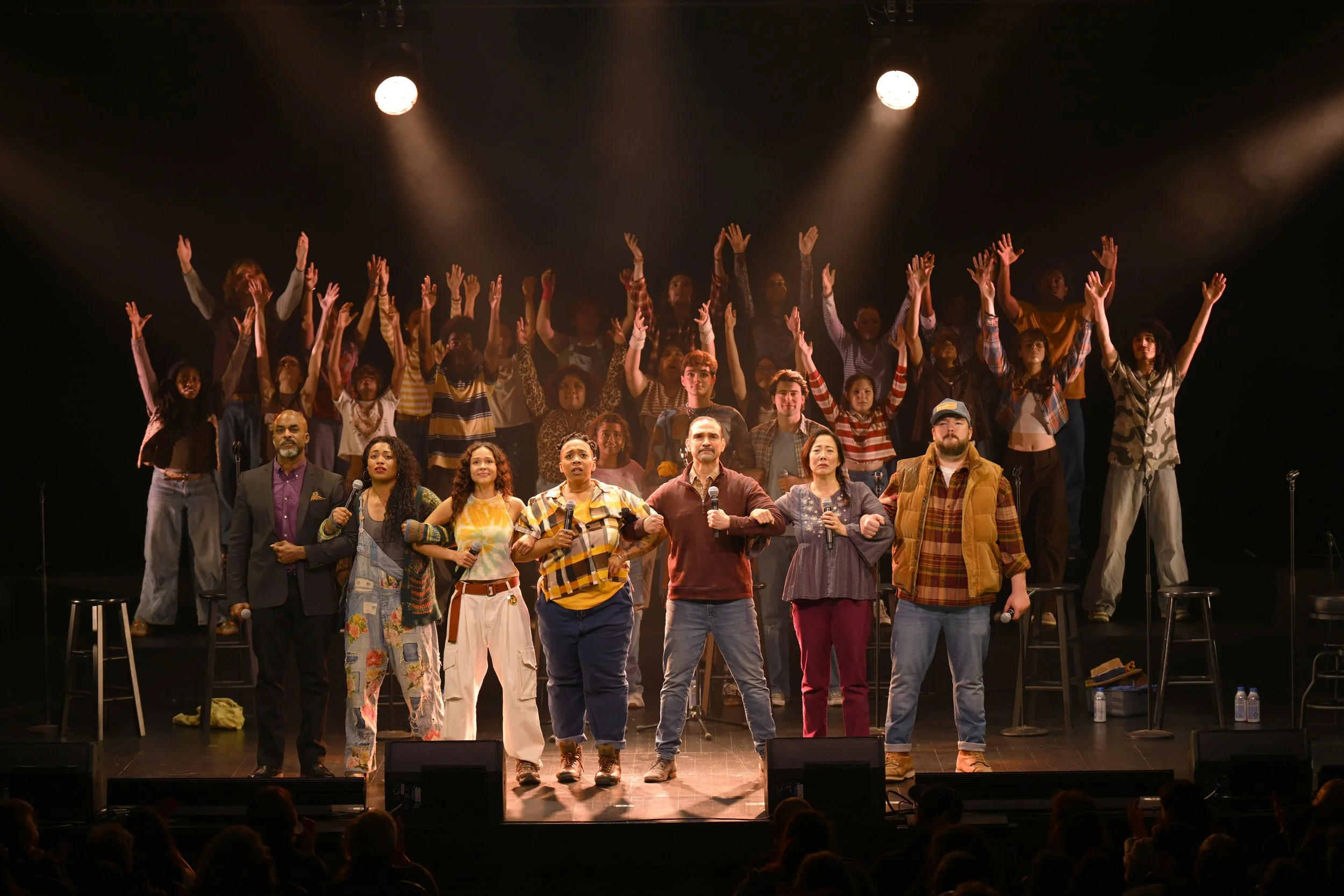
The cast of Dear Everything at Brooklyn Academy of Music on Earth Day, 2026
The Time Is Now
When twenty-two students from Broadway for Arts Education and Brooklyn Music School began rehearsals for Dear Everything this spring, few of them fully understood the scale of what they were about to become part of. They knew they had been cast in an Earth Day performance. They knew they would be working with professional artists. They knew the project was connected to climate activism and environmental justice. What they could not yet see was where those 6 weeks of rehearsal would lead: to the stage of the Brooklyn Academy of Music, one of the world's most respected performing arts institutions, and into a room filled with artists, activists, educators, and community leaders who had gathered to imagine a different future.
In Dear Everything, the students formed the Earth Choir, a group of young people living in a town that has agreed to sell its forest to a powerful corporation. Their role required far more than singing. They were asked to embody urgency, resistance, grief, joy, and collective action. They were asked to move with intensity, to take up space physically, and to communicate emotions that many adults struggle to articulate themselves.
The environmental themes at the center of the piece were not abstract concepts for the students. They are the generation that will inherit the consequences of decisions being made today. The anxiety, frustration, and determination woven throughout the production reflected concerns many of them already carried long before they entered a rehearsal room. In one of the show's most memorable songs, the Earth Choir delivers a direct message to the adults around them, singing, "We want you to panic. We want you to act. You stole our future and we want it back." Every time the students performed those lyrics, they landed with startling force because they felt less like theater and more like testimony.
Much of the transformation that took place over the course of the rehearsal process can be traced to the leadership of choreography and youth rehearsal director Christiana Hunte. Every educator has encountered the tendency among young people to hold something in reserve—to protect themselves by not fully committing, to offer eighty percent instead of one hundred, to keep a little distance between themselves and the possibility of failure. Christiana consistently challenged students to move in the opposite direction. She saw potential that they did not yet recognize in themselves and refused to let them settle for less than they were capable of achieving. Week after week she asked for more energy, more specificity, more physicality, and more honesty. What emerged was not simply stronger performance work but a level of artistic investment that surprised even those of us who knew the students well.
Before rehearsals began, I assumed that sustaining professional-level focus would be one of our greatest challenges. Instead, the students rose to the occasion almost immediately. As they learned more about the artists behind the project—including director Diane Paulus, writer V, and narrator Jane Fonda—their understanding of the opportunity deepened. Yet the significance of the experience did not fully register until performance day, when they walked into the BAM Opera House and encountered the production in its final form. Suddenly there were lighting designers, sound engineers, stage managers, cameras, crew members, and a packed audience. The scale of the event became tangible in a way that no rehearsal could have prepared them for.
One parent later described arriving at BAM without realizing the magnitude of the production her child had been participating in. Like many parents, she had spent weeks dropping her daughter off at rehearsals, assuming it was another worthwhile extracurricular activity. Standing in the theater that evening, surrounded by thousands of audience members and watching her child perform in a production operating at the highest professional level, she realized this was something altogether different. That sense of surprise was shared by many families who discovered new dimensions of their children's abilities over the course of the evening.
Perhaps nowhere was the students' growth more visible than in the production's climactic moments. As the conflict at the center of the story escalates, the Earth Choir refuses to accept the destruction of the forest and revolts. The students transform into animals, retreat into the woods, and become part of the natural world they are fighting to protect. It is a sequence that requires tremendous physical commitment. The students must vocalize, move, and sustain an almost overwhelming level of energy. Throughout rehearsals, Christiana continually pushed them further, challenging them to find a level of intensity that felt truthful rather than performative. Watching them onstage at BAM, fully committed to the moment and giving more than I had ever seen them give before, I found myself thinking that I had never seen these young people perform at this level.
What made the performance so moving was not simply its artistic quality but the sense that every element of the evening was reinforcing every other. Young activists saw young artists giving voice to fears they shared. Artists were reminded of the urgency of the climate crisis. Parents witnessed their children stepping into new versions of themselves. Students who had spent weeks working alongside professionals realized that they belonged in the same room and on the same stage. The project became a rare gathering point where different parts of the social change ecosystem—artists, activists, educators, families, and young people—could learn from one another and renew one another's sense of purpose.
Long after the final curtain call, families and audience members lingered outside the stage door celebrating the experience. Students posed for photos, congratulated one another, and struggled to process what they had just accomplished. Parents spoke with a mixture of pride and disbelief about the performances they had witnessed. The excitement was not simply about having participated in a successful production. It was about recognizing a capacity that had previously been hidden. The students left BAM with a clearer understanding of what they could contribute, how hard they could work, and what was possible when they committed themselves fully to something larger than themselves.
The most enduring lesson of Dear Everything may be one that adults need to hear as much as young people. We often speak about students as future artists, future activists, future leaders, and future changemakers. The experience at BAM offered a different perspective. Young people do not need to wait until some later stage of life before contributing meaningfully to the issues that shape our world. They are already thinking deeply about those issues. They are already creating, organizing, advocating, and imagining better futures. Given the opportunity, they are more than capable of rising to the occasion.
The students of the Earth Choir did not spend an evening pretending to be the future. They reminded everyone in the room that the future has already arrived.