Module 3
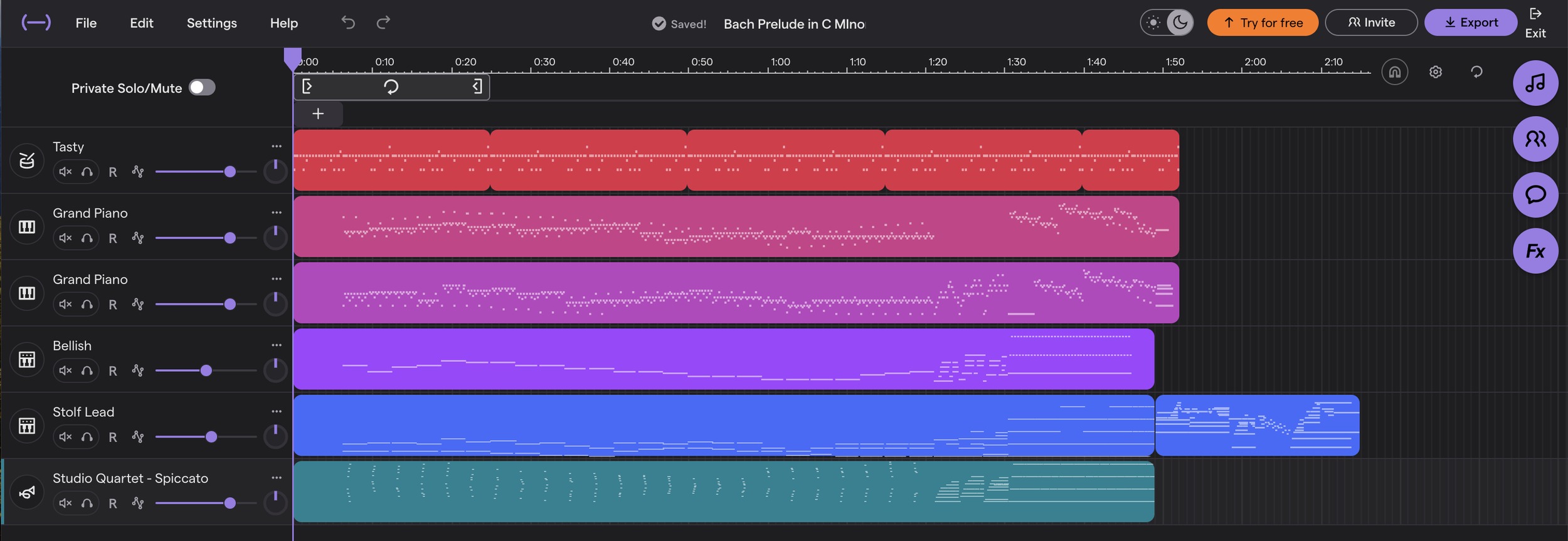
3.1 135 Seconds in SoundTrap: Bach Prelude in C Minor
3.2 MIDI from the web SoundTrap
Collaborative Link: https://www.soundtrap.com/signup?ref=1350243c25bc8cef0a99aeefd98cc852Links to an external site.
Source: https://www.kunstderfuge.com/mozart.htm#SonatasLinks to an external site.
Mozart Piano Sonata No. 16 in C major, KV 545 (1788)

Benjamin Houghton
Module 3 Summary, Synthesis, & Inquiry
Summary
The two readings (Pendergast and Bell) discussed ways to incorporate music technology into the classroom focusing on topics ranging from tips and techniques on how to build lessons and projects using Digital Audio Workstations, to the obvious and hidden ways that using music technology can encourage and hinder critical thinking, musicianship, and original composition. Both authors agree that music technology has greatly increased educators’ abilities to “unlock the hibernating musician within.” but Pendergast’s article appeared to highlight and offer his own ideas and creations, using Webster’s Model of Creative Thinking in Music as a main source, while Bell’s had a much more scholarly approach with a broader use of citations and quotes from external sources.
The Pendergast article had an overarching instructional tone, while the Bell article took a much more philosophical approach. Pendergast’s article included several ready-to-use lesson plans and curricular resources designed for educators who may feel “ill-equipped to operate DAWs or facilitate DAW-based music instruction” (Pendergast 45). The Bell article warned about the the “constraints” of using “conventions,” - which one could argue are the resources Pendergast offered in his article - while Pendergast encouraged educators struggling with which direction to go in to use his templates as a scaffolding and use their discretion to decide “which projects or resources might be most appropriate for your classroom,” with definitions of stand alone, EMP, general, or multimedia approaches to music technology projects.
The implied objective of the Pendergast article was what to teach in a music technology classroom with several resources that could be lifted directly off of the page, while the implied objective of the Bell article was how to teach in a music technology classroom, with a 5-step process for critical thinking when it comes to introducing a democratized music technology curriculum. Both articles focused on the pros and cons of democratizing access under the guidance of a skilled educator, with the evolution of what Pendergast calls the “hybrid musician” who can compose, perform, arrange, and edit (abilities that were once reserved only for professionals in the recording industry) with or without having access to traditional instruments and instrumental instruction. Students can even compose, perform, arrange, and edit without having access to other people (Quinn, 24) with technology affording students the ability to explore on their own, go through the critical thinking process at their own pace (“time away” in Webster’s Model of Creative Thinking in Music), derive greater meaning, challenge and innovate more than they could in a classroom setting. However, Bell shares two opposing viewpoints: an Evan Brooks quote that argues that “if you allow anybody to make music, anybody will make music, which is a whole other set of unintended consequences” (those consequences were not defined, but perhaps alluded to compositions made by combining pre-made loops together as opposed to understanding the micro building blocks of music) and a Regelski quote that counters with “composition software is frequently marketed as though for musical dimwits, but results are limited primarily by the musical skill and knowledge of the user - abilities that can be advanced by school-based composition students.”
Both objectives implied that the lure of universal truths always led to instruction guided by more presumed, privileged, protected, and prevented structures, and that it is the responsibility of the educator use their critical thinking skills to identify presumptions, to understand when defaults and presents are not in alignment with the classroom’s cultural capital and build bridges, to illuminate information that may not be readily obvious/accessible, and to identify barriers and preventions for their specific community of students. The educator also has a great responsibility to whittle down 20,000 options in each of Bell’s 5 phenomena (presumed, privileged, provided, protected, and prevented) into a handful of options based on the educator’s knowledge of who is in their classroom and what their unique scaffolded needs are.
They both explored the concept of the tool versus the user. Bell argues that “DAW mastery does not make you a musician, just as word-precessing mastery does not make you a literary laureate” (Bell 46) and posed questions about the power of the tool lying not in its potential, but the training of the hand that wields it. He challenged his claim with a quote by Gibson, 2006 that states “objects do not possess sociality, people do, and it is through the embodied nature of intersubjective human social action that objects come to have contingent relevance.” Technology can break down barriers of traditional instruments and use iPads as “highly accessible music-making environments” for low-income students, students with disabilities, and a range of other accessibility marginalizations. They argue that the technology designers may restrict creativity in their design decisions, but also acknowledge that affordances of musical instruments based on their physical structures and limitations have long existed. Having access to these tools allows students to engage in trial and error, patience to “prepare, work through, take time away, and verify” (Webster’s Model of Creative Thinking in Music) on their own time instead of in a group classroom setting that may not have luxury to give those processes their due time.
Bell summarizes my biggest takeaway from these articles when he says it is the responsibility of the educator’s “analytical ability…to recognize the affordances, constraints, and conventions of technology.” In regards to my own working philosophy of music technology education, if the goal is not to create musicians but to create critical thinkings who are able to use those skills to preserve in any situation, then access to DAWs that may over democratize music making or unintentionally privilege/protect/prevent information poses no threat. A well structured lesson plan that sharpens critical thinking skills is beneficial to any student, whether or not they go to become professional musicians or even learn the more granular building blocks of music. Brown states that “technologies…are never neutral or invisible” - and neither will a teacher ever be. That is why it is so important to teach students how to think critically and give them the skills to draw their own conclusions about the affordances of their music education tools. “Universal” technology for the masses combined with a personalized teacher is the ideal match. Bell offers that “proverbs exist because they have repeatedly run true and resonated within a culture.” Incorporating technology into the classroom is worth the risk, because in engaging with “proverbial” structures created by “proverbial” software engineers, it teaches students to use critical thinking skills that challenge cultural norms, understand the influence of design, and ultimately create new ideas.
WC: 1084
Inquiry
What are the pros and cons of having music/composition/recording accessible to all?
How can you apply the 5 P’s of Bell’s 5 pronged approach to traditional musical instruments and learning/composing styles?
Which traditional/human elements of music-making are hardest to replicate in a DAW? Which are the easiest?
How could you use Webster’s creative thinking process to scaffold out a year of curriculum?
What non-musical technology skills must be taught before developing musical skills through a DAW?
How can you introduce a music technology assignment in a way that is relevant to a student's sociocultural identity?
Reference Page
Pendergast, Seth. “Creative Music-Making with Digital Audio Workstations” National Association for Music Education, 2021
Bell, Adam Patrick “Can we afford these affordances: GarageBand and the double-edged sword of the digital audio workstation. Action, Theory, and Criticism for Music Education, 2015