Module 4

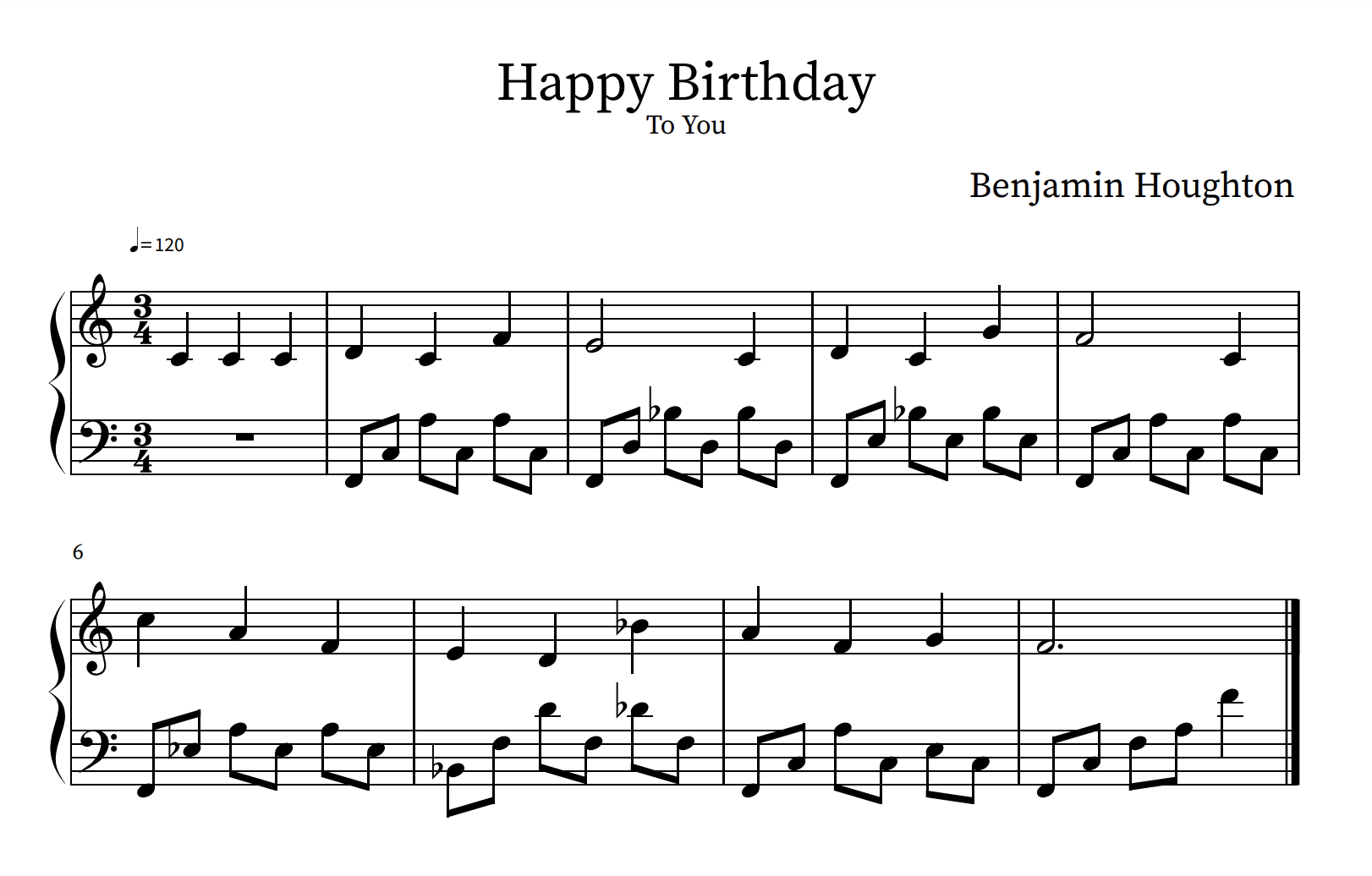
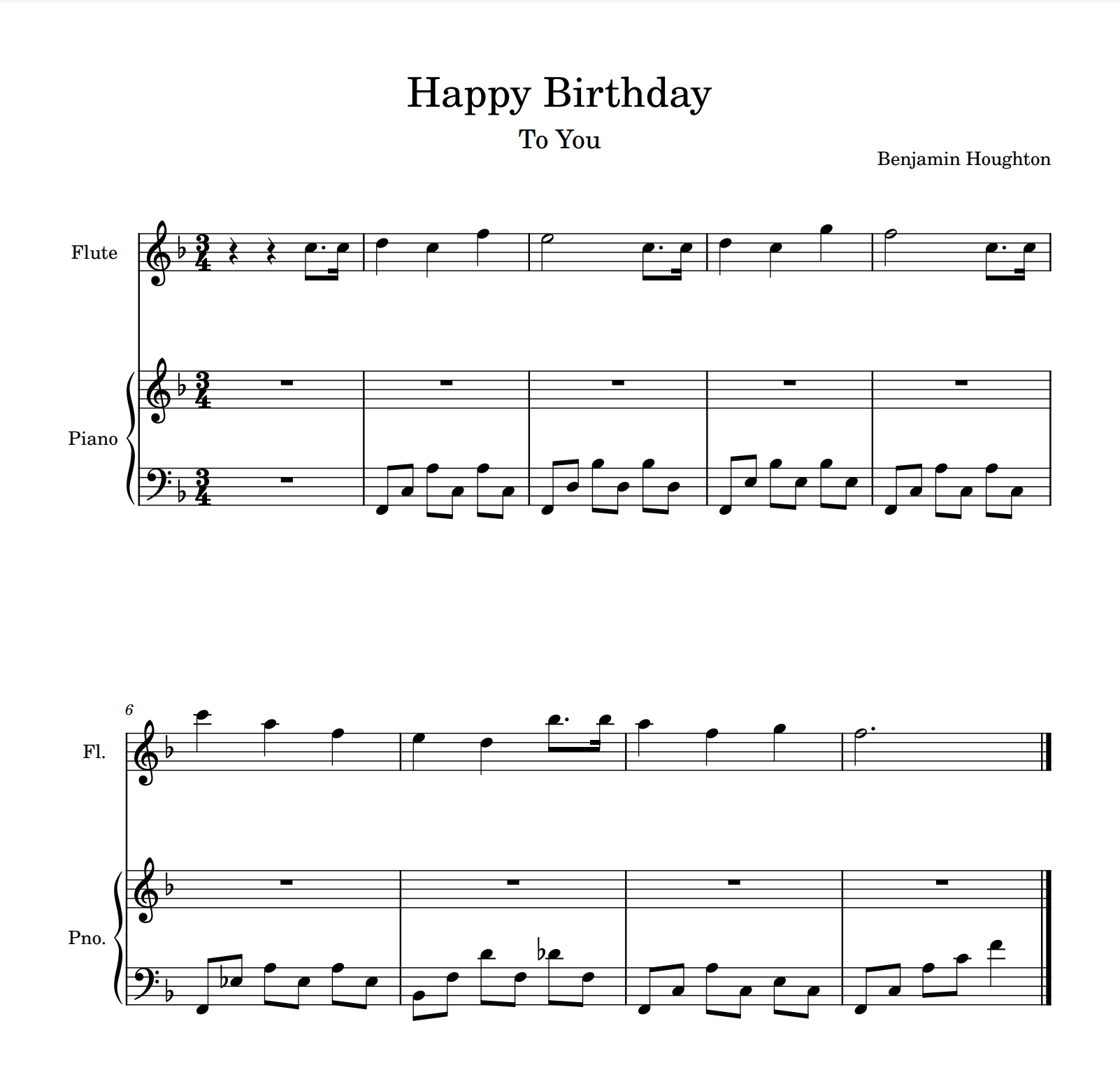
4.2 Happy Birthday in Two Notation Softwares (Noteflight & Musescore)
Module 4 Summary and Synthesis
Summary
Renee Ducan’s 2021 journal article, Cognitive Processing in Digital Audio Workstation Composing, is a synthesis of Duncan’s personal classroom experience and conclusions drawn by educators, psychologists, and other researchers. The synthesis draws connections between how different cognitive functions are enhanced and/or hindered when engaging with digital audio workstations. Duncan’s arguments are organized in seven cognitive processes that are activated when students interact with GarageBand and Soundtrap. The article did not address if the variances of Garageband or Soundtrap influenced different cognitive outcomes, but rather referenced them as having indistinguishable effects on the seven cognitive processes.
Duncan uses the Oxford University Press’s 2020 definition of cognition (“the mental action or process of acquiring knowledge and understanding through thought, experience, and the senses”) as the foundation for an emergentist view that the combination of the known and unknown are what lead to students “participating in the creation of an unfinished universe” (Osberg et al., 2008 [from the other reading, I know, but I loved it so much I wanted to include it!]. To compose music, whether using a DAW or not, requires “planning, monitoring, and evaluation” (Bugunovic, 2019, p97) and these cognitive functions can be amplified or disabled if the meeting of existing knowledge with the introduction of new knowledge (in context of these six categories: cognitive tools, audio-visual processing, decision making, social cognition and group think, and hypermedia) is not guided by a skilled teacher who can effectively scaffold instruction.
Jonassen & Reeves (1996) take a socio-material perspective in their claim that cognitive tools “enhance thinking, problem solving, and learning.” That claim is supported by Ducan’s warning that the tools may get in the way of critical thinking if they are not introduced to the learning in a carefully scaffolded way. Before composition can begin, students must acquire technical knowledge and understand the features and functions of the tool, as well as answer the questions of what, how, and why (in that order) they are composing.
Before those questions can be answered, Duncan, supported by Meyer (2001) asserts that “audio-visual processing happens before cognitive function” and that teachers must be aware that the students may be hindered by the inability to process both audio and visual stimuli simultaneously. To reduce the cognitive load, Duncan suggests teachers experiment with one stimulus at a time, to make sure students are differentiated between what looks good and what sounds good. Teachers must take a scaffolded approach to connect what students are seeing on a screen to what students are hearing.
In a callback to Bell’s 5 affordances, Duncan asserts that the overabundance of choice may hinder cognitive processing abilities. DAWs afford students with a paralyzing amount of options to choose from - be it instrumentation, loops, effects. Good decision making comes from taking the time to analyze all options before executing. That is nearly impossible in a DAW like Sountrap or Garageband, so Duncan suggests limiting the options to a style or loop or a group of instruments to not overwhelm students’ decision making cognitive function. To me, the concept of hypermedia overlaps with decision making - there can be almost too many choices when organizing the available data. Depending on the cognitive function and developmental stage of the child, the scaffolded guidance of a teacher is an important element to make the DAW accessible and not overwhelming.
While not at all exclusive to the use of the DAW, engaging in a group setting with Soundtrap or Garageband can inherently lead to a diminishing of cognitive and/or creative function when students engage in suboptimal decision making in an attempt to avoid conflict (Sternberg & Sternberg). It is the teachers responsibility to make sure that strong collaboration skills have been scaffolded so that students find group work an opportunity to generate new ideas and receive diverse feedback, rather than limiting creative capacity.
While Duncan categorized Teacher Guidance as one of the seven cognitive processes, my biggest takeaway from this article is that the most important ingredient for optimal student cognition is the guidance of the teacher who has scaffolded DAW activities with awareness of the benefits and pitfalls of the six other cognitive processes.
Throughout the article, I found the Richard E. Mayer quotes from his article A cognitive theory of multimedia learning the most in alignment with my takeaway that a teacher’s scaffolded guidance is the foundational element to nurturing successful cognitive processes in students. In the article, accessed via the Digital Learning Institute, Meyer outlines a 12-point checklist on how to structure multimedia learning experiences. The visual aspects of Digital Audio Workstations make music composition an inextricably multimedia practice, and multiple doors for diverse learners with multiple intelligences to thrive. DAWs, with their provided and presumed affordances, support Mayer’s Limited-capacity assumption that individuals “have a limited ability to absorb information at any one time.” While it may be possible to argue that provided and presumed affordances are undemocratic, Mayer’s research asserts that the human brain can not optimally function in a “true democracy” where all options are available. From Mayer’s 12-point checklist, I take away that It is as much the job of the software designer as it is the guiding teacher to draw students attention to vital information (signalling principle), to offer information in a variety of ways (redundancy principle), to provide information at the same time (temporal contiguity principle), and to give students control over the pace at which information is communicated (segmenting principle). Meyer’s work continues to support my assertion that informed scaffolded teacher guidance is the most effective way to educate students.
Reference Page
Sternberg, R. J., & Sternberg, K. (2012b). The landscape of memory: Mental images, maps, and
propositions. In Cognitive psychology (6th ed., pp. 269–318). Wadsworth.
Mayer, R. E. (2001). A cognitive theory of multimedia learning. In Multimedia learning (pp. 41–63).
Cambridge University Press. https://doi.org/10.1017/CBO9781139164603
Duncan, Renee (2021). Cognitive Processing in Digital Audio Workstation Composing. National
Association for Music Education.